





Job Scheduling for IT and Systems Administrators
Scheduled tasks distributed across hundreds of servers create version control challenges and outage risks. Task Scheduler, cron jobs, and custom scripts each use different scheduling mechanisms, making centralized management difficult. When a critical batch job fails at 2 AM, diagnosing the issue requires checking multiple systems. JAMS provides a single platform for defining, monitoring, and managing automation across your infrastructure—with visibility into dependencies and execution status across all servers.
Centralize Infrastructure Automation Across Your Environment
Infrastructure automation often exists in fragments—Windows Task Scheduler on some servers, cron on Linux systems, SQL Agent for database jobs, and custom scripts in various locations. This fragmentation creates operational blind spots and inconsistent execution standards. JAMS addresses these limitations:
Relational Job Diagram View
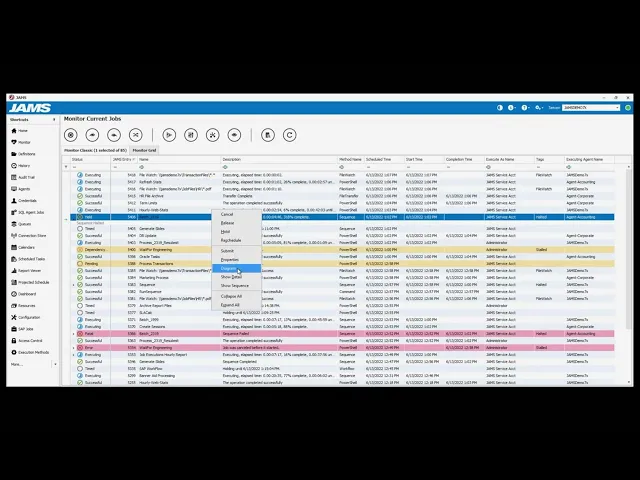
The Relational Job Diagram in JAMS gives you an instant visual map of how your jobs connect to each other. This short tutorial shows you how to open it, read it, and use it to trace dependencies at a glance.
Open the Relational Job Diagram for any job or workflow
Understand upstream and downstream dependency relationships
Use the diagram to identify bottlenecks and single points of failure
Infrastructure Automation Challenges JAMS Addresses




How Systems Administrators Use JAMS

Manufacturing IT Team Consolidates 400+ Scheduled Tasks
A manufacturing IT department managed over 400 scheduled tasks across 75 Windows servers using Task Scheduler. Version control required manual updates to each server, failures often went unnoticed until business impact occurred, and audit preparation required weeks of log gathering. After migrating to JAMS, the team reduced maintenance time by 65%, achieved 99.8% job success rate with automated recovery, and cut audit preparation from three weeks to two days with centralized logging.

Healthcare System Administrator Reduces After-Hours Incidents
A regional healthcare system managed batch processes with complex dependencies that were not documented or enforced in the scheduling system, leading to cascading failures. The primary administrator spent 10-15 hours monthly responding to failed jobs, often requiring late-night interventions. JAMS dependency management and intelligent retry logic reduced after-hours incidents by 87%, while automated escalation ensured critical issues reached on-call staff immediately with full diagnostic context.

Financial Services Infrastructure Team Improves Compliance Posture
A financial services firm faced challenges during SOC 2 audits due to automation scattered across Windows, Linux, and mainframe systems. Proving execution history—who ran what job, when, and why—required manual log correlation across multiple platforms. JAMS provided unified audit trails with immutable logging, role-based access controls, and automated compliance reports that reduced audit preparation from 80 hours to under 10 hours quarterly.
Enterprise System Integrations
JAMS natively connects with leading database platforms, cloud services, and legacy systems, acting as an orchestration layer for your enterprise ecosystem.






Why Leading Organizations Choose JAMS
Businesses worldwide rely on JAMS for enterprise job scheduling:
Our orchestration solution is rigorously tested and trusted by organizations that demand reliability, including Raymond James, Coca-Cola Canada, and Teradata.
G2 reviews highlight JAMS as a “game-changer,” streamlining complex processes and providing “true cross-platform automation.”
Our expert team is available 24/7 to assist with your operations, ensuring smooth and efficient execution whenever you need support.